Ozone (O3) is one of the most powerful commercially available oxidants. It destroys bacteria, viruses, and odors up to 3,000 times faster than chlorine. But unlike chemical dosing, you cannot buy ozone in a bucket. It must be generated on-site and dissolved into water instantly。
For engineers and plant operators, understanding the specific mechanics of this system is critical. A successful ozone system isn't just a generator; it is a chain of four distinct subsystems: Feed Gas Preparation, Ozone Generation, Mass Transfer (Injection), and Destruction。
This guide breaks down the technical process description of ozone disinfection and purification, moving beyond basic definitions into operational realities。
Before looking at the machinery, you must understand the chemical reaction occurring in the water. Ozone is an unstable molecule composed of three oxygen atoms. It desperately wants to revert to stable oxygen (O2)。
To do this, it sheds a single oxygen atom. This free radical is highly reactive. When it encounters a bacteria cell or an organic contaminant, it initiates oxidation。
Most operational failures in ozone systems do not start at the generator. They start at the air source。
You cannot feed humid, dirty ambient air into a corona discharge cell. If moisture enters the generator, it reacts with nitrogen to form nitric acid. This acid builds up on the dielectric tubes, destroying the equipment within weeks。
The process begins with Gas Preparation. There are two primary methods:
If using air, it must be compressed and passed through desiccant dryers. The air must be dried to a dew point of at least -60°C (-76°F). This ensures zero moisture enters the reaction chamber。
Modern industrial systems prioritize Oxygen Concentrators over simple air. Using Pressure Swing Adsorption (PSA) technology, the system separates nitrogen from the air, delivering 90-95% pure oxygen to the generator。
Once the gas is clean and dry, it enters the Ozone Generator。
While UV ozone generation exists, it is too weak for most industrial water treatment applications. The industry standard is Corona Discharge (CD)。
Imagine a man-made lightning storm contained within a stainless steel tube。
1。 The Dielectric: The generator contains a dielectric material (usually glass or ceramic) sandwiched between two electrodes。
2。 High Voltage: A high-voltage current is applied across the dielectric gap。
3。 The Split: As the oxygen gas (O2) flows through this electrical field, the energy splits the oxygen molecules into single atoms (O)。
4。 Recombination: These single atoms instantly attach themselves to other O2 molecules, forming Ozone (O3)。
This process generates massive amounts of heat. Heat is the enemy of ozone; it causes the molecule to decay back into oxygen before it ever leaves the machine. Therefore, a robust Cooling System (usually a closed-loop water chiller) is integrated into the generator jacket to maintain efficiency。
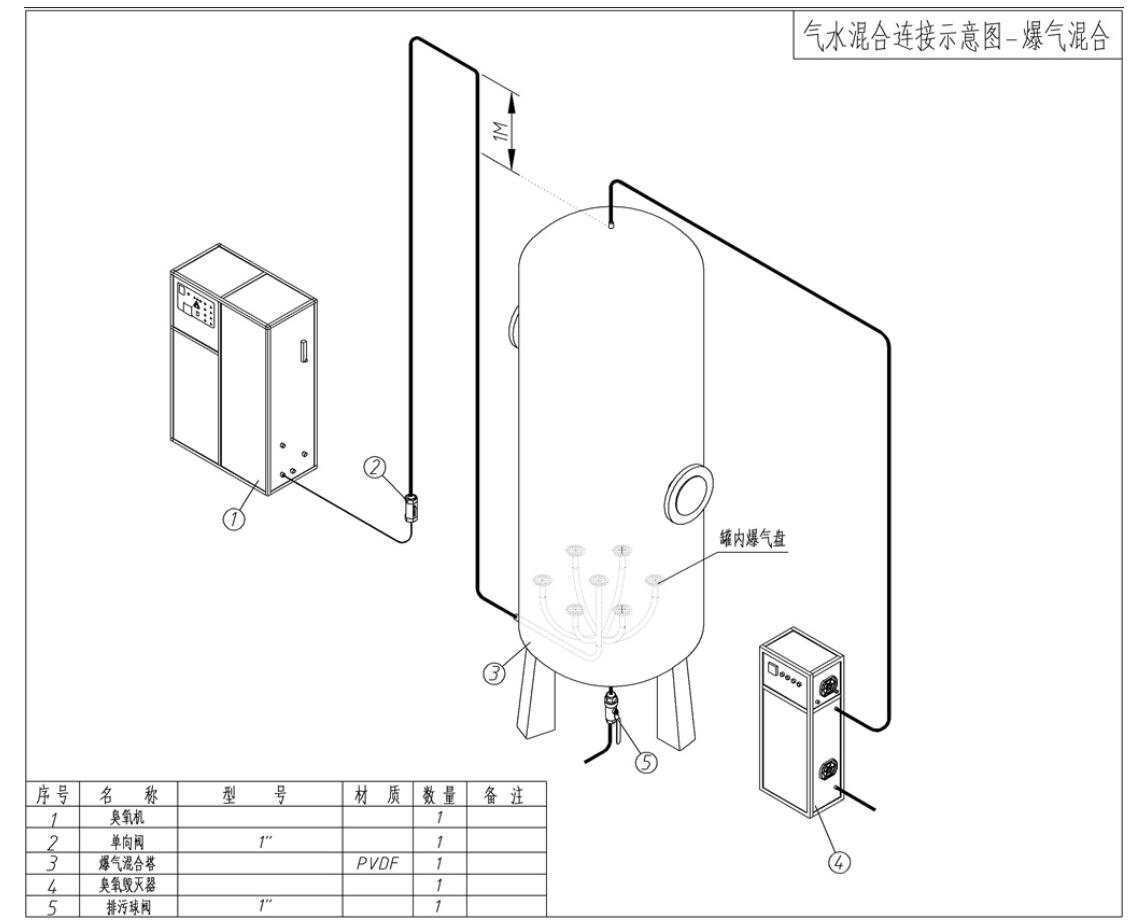
Generating the gas is the easy part. Dissolving a gas into a liquid (Mass Transfer) is where the engineering challenge lies. Ozone is only partially soluble in water。
Old systems used “Fine Bubble Diffusers” (air stones) at the bottom of a tank. This is inefficient. Bubbles rise to the surface too quickly, wasting expensive ozone。
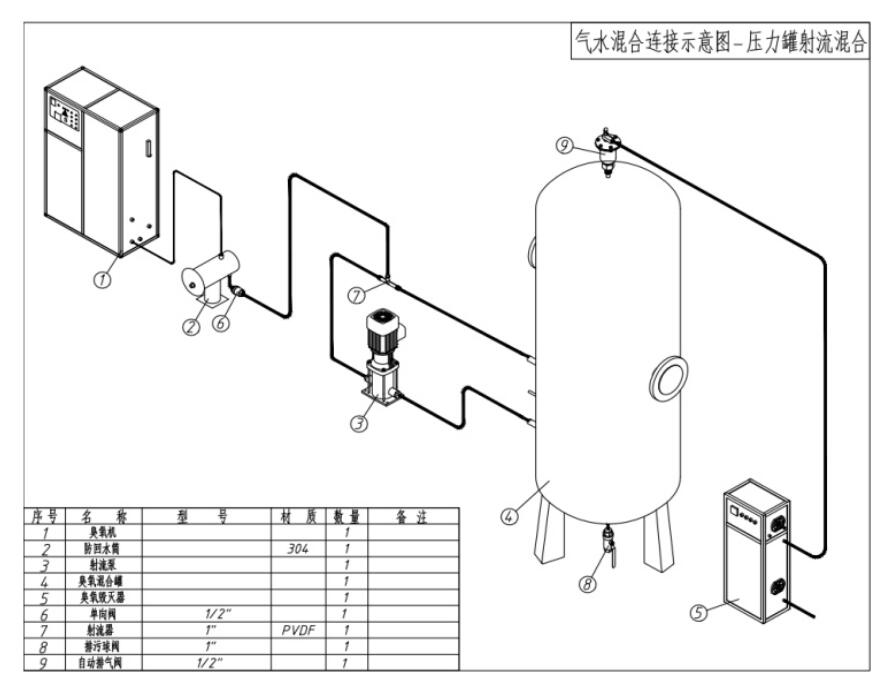
The most effective process uses a Venturi Injector and a Side-Stream loop。
1。 Pressure Differential: A booster pump forces a portion of the water flow through a narrowing conical tube (the injector)。
2。 Vacuum Creation: As the water velocity increases through the injector, it creates a vacuum at the suction port。
3。 Violent Mixing: The ozone gas is sucked into the water stream. The shear forces at the injection point break the gas into microscopic bubbles, creating an emulsion。
Mass transfer efficiency with a Venturi system typically exceeds 90%, compared to 50-60% for bubble diffusers。
Immediately after the injector, the water flows through a Static Mixer. This is a pipe segment with internal baffles that twist and turn the flow. This further shears the bubbles and ensures the ozone is evenly distributed throughout the water volume。
The ozonated water (now carrying a high residual of dissolved ozone) is mixed back into the main water line and enters the Contact Tank。
Disinfection is not instantaneous. It requires specific exposure time. This is calculated using the CT Value:
CT = Concentration (mg/L) \times Time (minutes)
Different pathogens require different CT values. For example, Cryptosporidium requires a much higher CT value than E. Coli。
The Contact Tank is designed with internal baffles. These baffles force the water to flow in a serpentine path (over and under or side to side)。
Safety is non-negotiable. Ozone is a toxic gas and a lung irritant. You cannot vent undissolved ozone bubbles into the factory or the atmosphere。
At the top of the contact tank, a relief valve captures the gas that didn't dissolve. This “Off-Gas” is routed to an Ozone Destruct Unit。
Two technologies handle this:
1。 Thermal Destruction: Heating the gas to roughly 350°C, forcing the O3 to revert to O2。
2。 Catalytic Destruction: Using a catalyst (often Manganese Dioxide or copper-based) to strip the extra oxygen atom at room temperature。
The result is pure, safe oxygen released into the atmosphere。
For high-purity applications (like bottled water or pharmaceutical water), a UV light may be placed at the end of the water line to destroy any dissolved ozone remaining in the water before it hits the filler, converting it back to oxygen。
Blindly injecting gas is dangerous and inefficient. A robust process relies on real-time data monitoring:
Any honest description of the ozone process must address Bromate。
If the raw water contains Bromide ions (Br^-), ozone can oxidize them into Bromate (BrO3^-), a regulated carcinogen。
Mitigation Strategies:
For operators running these systems, here are common failure points:
Symptom: Low Ozone Concentration in Water
Symptom: Strong Ozone Smell in the Room
The process of ozone disinfection is a balance of physics and chemistry. It involves preparing a pristine gas, generating plasma through electricity, shearing gas into liquid through pressure, and managing time-dependent chemical reactions。
When designed correctly, it provides the cleanest water possible—free of pathogens, taste, and odor, without the chemical residue left behind by chlorination。
Does ozone remove heavy metals?
Yes, but indirectly. Ozone oxidizes dissolved metals like iron, manganese, and arsenic into insoluble particles (precipitates). These particles must then be removed by a physical filter (like sand or activated carbon) downstream of the ozone tank。
What is the half-life of ozone in water?
Ozone is short-lived. In clean water at 20°C, its half-life is roughly 20 to 30 minutes. In dirty water with high organic load, it may be consumed in seconds. This is why ozone does not provide residual protection in long municipal pipe networks。
Can I use an air compressor for ozone generation?
Only if you have an industrial-grade air dryer. Using standard shop air will destroy the ozone generator dielectric cell due to nitric acid formation from moisture and nitrogen。


